What is Web3?
September 11, 2024 · 6 min readWhat is Web3?
Web3 is a broad term for technologies like blockchain that decentralize ownership and data management on the Internet. Most internet applications are controlled by centralized organizations that determine how they store and use end-user data. Unlike centralized governance structures, Web3 technologies (also called Web 3.0, the decentralized web, or the semantic web) enable community-driven projects. In these projects, end users control their own data, set pricing, contribute directly to technical development, and play a larger role in shaping the project's direction. These technologies include mechanisms for automatically regulating user interactions, eliminating the need for centralized entities to manage them.
What are the core ideas behind Web 3.0?
Web 3.0 is defined by four key characteristics.
Decentralization
Decentralized web applications are a key feature of Web 3.0. The goal is to distribute and store data in decentralized networks. In these networks, multiple organizations own the underlying infrastructure, and users pay directly to storage providers for access.
Decentralized applications also replicate information across multiple locations, ensuring data consistency. Each user can independently control where their data is stored rather than relying on centralized infrastructure. In a decentralized web, users could even choose to sell their data if they wish.
Trustless Principle
In centralized web applications and services, users often rely on a central authority to manage data, process transactions, and mediate interactions. These central authorities control user data and can manipulate system rules. This makes data susceptible to security breaches or mismanagement, potentially leading to data loss or misuse.
Web3 removes the need for trust in centralized entities. Users can participate in transactions and interactions without having to trust a specific party.
Semantic Web
Through the semantic web, applications can execute complex tasks by analyzing the content and context of web data. The semantic web leverages metadata and artificial intelligence to interpret and provide meaning to user-provided data.
Web 3.0 aims for a full transition to semantic web technologies, some of which are already present in modern web applications. For example, search engines now provide more accurate and contextually relevant search results, while AI assistants help users complete tasks efficiently.
Interoperability
Web 3.0 envisions a seamless connection between different technologies, allowing data to move across platforms without intermediaries. With interoperability, users can transfer their data, switch between services easily, and retain their profiles and settings.
At the same time, Internet of Things (IoT) protocols extend the network beyond traditional boundaries. For instance, blockchain-based technologies enable borderless transactions, allowing users to exchange value across geographic and political boundaries.
Why is Web 3.0 important?
When the internet first emerged, most web services operated in a read-only format. Users could only consume content, which was published by companies that owned and maintained the infrastructure for static web pages.
With Web 2.0 technologies such as blogs and social media platforms, applications became interactive. Users could create and share content, but all interactions were regulated by centralized platforms. These platforms profit from user-generated content and often own digital assets created by users.
For example, freelance platforms connect workers with clients, while rental platforms link property owners with tenants. Service providers and users submit data, such as profiles, service descriptions, blogs, videos, and comments, but platforms retain full control over this data.
Problems with Web 2.0
While centralized platforms facilitate interactions, Web 2.0 introduces several problems:
- Service providers cannot transfer their data to other platforms without losing their business reputation and client base.
- Users do not control how their data is used or managed.
- Platforms have the power to filter user content, restrict access to certain features, or even ban users entirely.
Advantages of Web 3.0
Web 3.0 shifts towards a read/write/own paradigm. Creators retain ownership of their data, control how it is used, and influence how it is managed.
Here are some key advantages:
- Greater User Engagement: Users interact more meaningfully with services and each other, incentivized by active participation rather than passive data exchange.
- Enhanced Privacy: Users control who can access their data, and platform owners cannot view it. Your online actions may be public, but your identity remains private.
- Democratized Communication: Web 3.0 aims to remove corporate, geographic, and political barriers in communication. It minimizes big tech censorship and balances security with transparency.
What are the core technologies behind Web 3.0?
Many Web 3.0 applications rely on blockchain technology, which provides transparency, immutability, and a trustless framework. Blockchain is a decentralized and distributed ledger that records transactions or data across a network of nodes.
In a blockchain database, data is stored in chronologically linked blocks. These blocks cannot be altered or deleted unless the entire network reaches a consensus. This ensures an immutable and tamper-proof system for recording transactions.
Here are other key technologies behind Web 3.0:
Tokenization
Tokenization extends blockchain technology by representing real-world and digital assets as tokens.
Tokens act as cryptographic representations of ownership or access rights. They can represent real estate, stocks, goods, art, music, or even in-game assets.
Tokens can be divided into securities tokens (regulated financial instruments) or non-fungible tokens (NFTs), which represent unique, indivisible assets.
WebAssembly (Wasm)
WebAssembly (Wasm) is a binary instruction format for a stack-based virtual machine. It runs inside the browser’s isolated environment, preventing access to the user’s local file system.
Wasm enables high-performance execution in web applications, making Web3 dApps (decentralized applications) faster and more efficient.
Semantic Web Technologies
Semantic web technologies help applications better understand and interpret data. They enable structured and linked data models, making information machine-readable.
Examples include:
- Resource Description Framework (RDF): Uses triples (subject-predicate-object) to define relationships between entities.
- Web Ontology Language (OWL): Defines classes, properties, and instances to model knowledge and infer new insights.
What are some examples of Web 3.0 applications?
Smart Contracts
Smart contracts are self-executing contracts with predefined rules written in code. They automatically enforce agreements when conditions are met.
For example, a smart contract could automate mortgage payments, bonds, or securities trading, eliminating intermediaries and improving security.
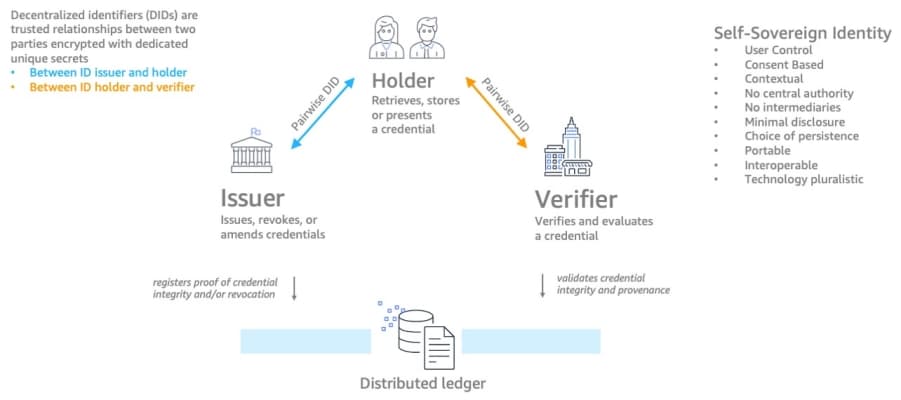
Decentralized Identity
Decentralized identity solutions give users control over their digital identities.
Instead of relying on social media logins, users create decentralized identifiers (DIDs) that store personal credentials privately while allowing selective disclosure when needed.
InterPlanetary File System (IPFS)
IPFS is a peer-to-peer file storage system that eliminates the need for centralized servers. Each file is assigned a cryptographic hash, ensuring decentralized and resilient content delivery.
Author of the original post: Amazon Web Services